1 Inch Objects: 15 Everyday Things That Are About 1 Inch Long
How long is 1 inch? An inch is a common unit of length used mainly in the United States and a few other countries. It is a small measurement that helps describe the size of everyday objects. One inch is equal to 2.54 centimeters (cm) or 25.4 millimeters (mm). When people ask how long is an inch or how big is an inch, they are usually trying to understand its real-life size in a simple way.
How Long Is 1 Inch?
A 1 inch measurement is a standard unit of length equal to 2.54 centimeters. Many people search for how long is an inch, how long is a inch, or want to know the exact 1 inch length for everyday measurements.
If you are wondering how many centimeters are in one inch, the answer is 2.54 cm. Whether you call it inch, an inch, or one inch, it is commonly used to measure small objects and distances.
Many people also ask how big is an inch, how big is a inch, and how big is one inch. The easiest way to understand its size is by looking at common things that are an inch long.
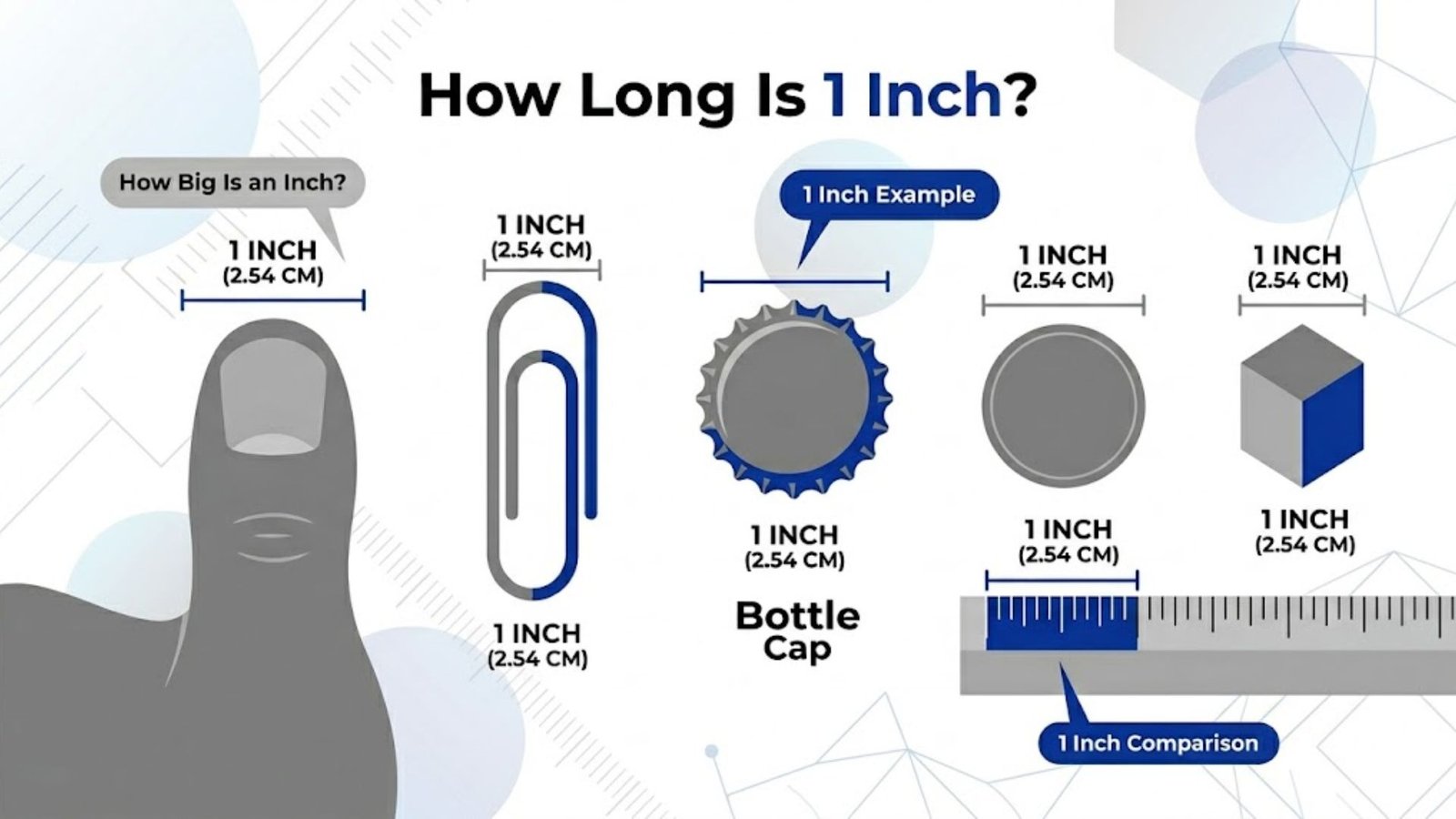
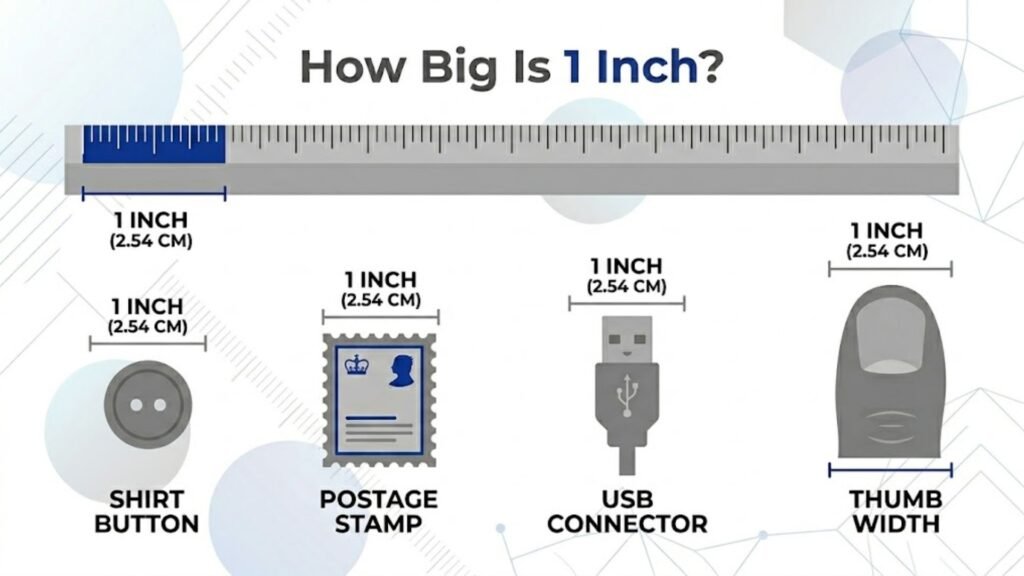
Some popular things that are 1 inch include the width of an adult thumb, a large paperclip, or the diameter of a U.S. quarter. These everyday 1 inch objects provide a simple 1 inch example and help visualize the actual size of 1 inch without using a ruler.
A useful 1 inch comparison can make measurements easier to understand. Knowing how long is 1 inch is helpful when reading size guides, measuring products, or using a Conversion table inch mm – decimal and fractional chart.
For example, many conversion charts include values such as 3/16 to mm, 5/16 to mm, 7/16 to mm, 13/16 to mm, and 3/8 to mm to convert fractional inch measurements into millimeters.
Understanding 1 inch, one inch, and common 1 inch objects makes it easier to estimate lengths accurately in everyday situations.
How Long Is 1 Inch in CM and Millimeters?
How long is 1 inch in cm and millimeters? One inch is exactly equal to 2.54 centimeters (cm) and 25.4 millimeters (mm).
This standard conversion is used worldwide in measurement, engineering, construction, and everyday calculations. If you need to convert inches into metric units, simply remember that 1 inch = 2.54 cm = 25.4 mm.
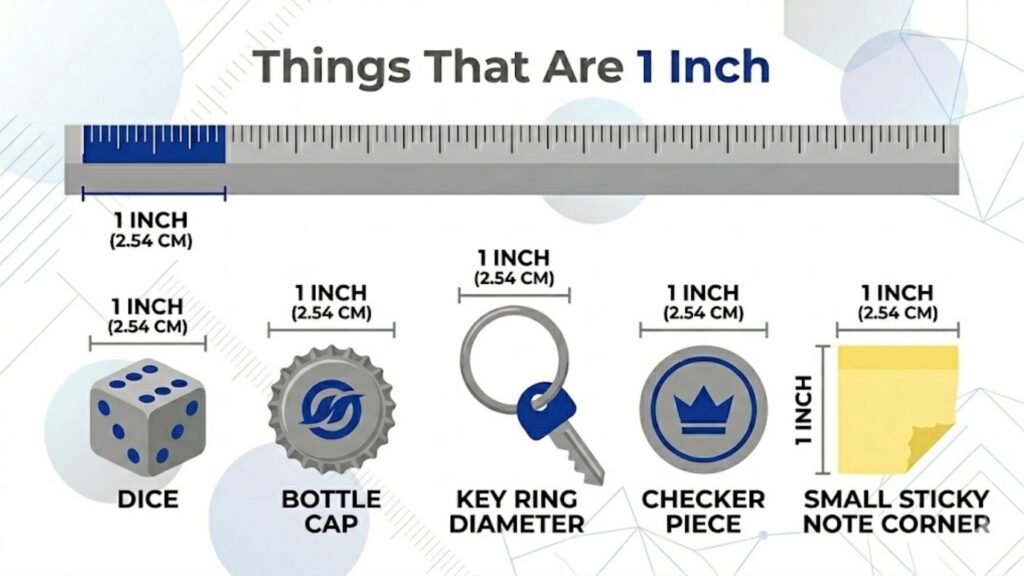
To better understand how long is 1 inch, imagine the width of an adult thumb or the diameter of a large coin. These common examples help visualize the size of one inch without needing a ruler.
Since centimeters and millimeters are metric units, converting inches is useful when working with international size charts, technical drawings, or product dimensions.
Here is the simple conversion table:
| Inches | Centimeters (cm) | Millimeters (mm) |
|---|---|---|
| 1 inch | 2.54 cm | 25.4 mm |
1 inch in cm (2.54 cm)
Understanding the conversion of inches to centimeters is crucial in a world where metric measurements dominate scientific and academic fields.
One inch equals 2.54 centimeters, making it a handy reference for anyone transitioning between systems. This equivalency highlights the precision of the metric system, which is often preferred for its straightforward calculations compared to traditional imperial units.
1 inch in mm (25.4 mm)
When you delve deeper into the metric system, the conversion of 1 inch to millimeters reveals an even more detailed measurement: 25.4 mm.
This finer granularity allows for increased accuracy in tasks such as engineering, construction, and crafting.
It’s fascinating to observe how such a small unit can have a substantial impact on design specifications and product dimensions, ensuring that every detail adheres to stringent standards.
Quick conversion table
A quick reference conversion table can simplify everyday tasks where measurements are involved. For instance, knowing that 1 inch equals 2.54 cm and 25.4 mm can save time and reduce errors when purchasing materials online or rotating between measurement systems.
This accessibility encourages precision in various domains, from home improvement projects to fashion design.
Why 1 inch matters in measurements
Inch measurements are foundational in many cultures, especially in the United States, where they are prominently used in construction and manufacturing. Understanding this unit facilitates smoother communication in these industries.
knowing how it converts into metric measurements empowers you to operate effectively on a global stage, ensuring you remain connected and competitive in an increasingly international marketplace.
What Does 1 Inch Look Like in Real Life?
If you are wondering what does 1 inch look like in real life, it is a very small length equal to 2.54 centimeters (cm) or 25.4 millimeters (mm).
To visualize it easily, think of a short distance that is just a little wider than the tip of your thumb or slightly larger than a small coin. This is what 1 inch looks like in everyday life.
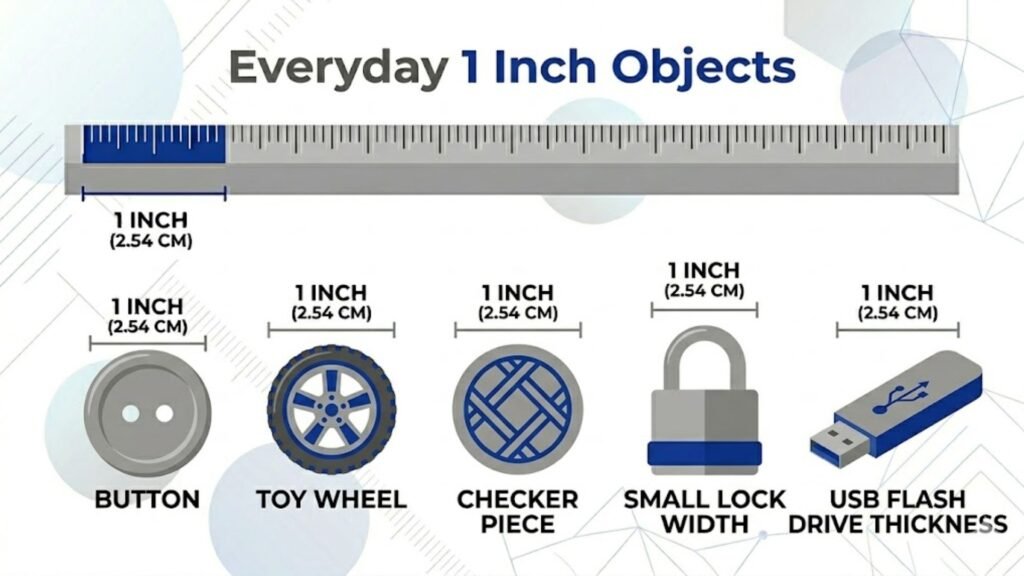
In real objects, 1 inch objects include the diameter of a U.S. quarter coin, the width of a large paperclip when straightened, a standard button on a shirt, or the thickness of a USB port edge.
These things that are 1 inch help you quickly understand how big is an inch without using a ruler. When people ask how long is 1 inch or how big is one inch, these simple examples make it easy to imagine the size.
Compared to a Ruler
One inch is a small yet significant measurement, often marked clearly on a ruler. When you look at a standard 12-inch ruler, the one-inch mark is just a sliver of the entirety, but its importance is undeniable.
It’s the foundation of countless DIY projects, serving as a reference point for precision in carpentry, crafting, and more. Visualizing this measurement next to its larger counterparts highlights how one inch can often be overlooked, yet it plays a crucial role in achieving accuracy.
Compared to a Finger Joint
A finger joint provides a more intimate dimension for gauging one inch, particularly if you measure from the bottom of the nail to the tip of the first joint.
This anatomical reference makes the measurement relatable and personal. When you see that your finger joint aligns with an inch, it becomes easier to appreciate how such small increments can substantially affect everyday tasks, whether it’s cooking or sewing.
The human body serves as a natural ruler, emphasizing how our physicality can translate into measurements in a practical way.
Compared to a Coin
Using a coin as a comparison brings a tangible aspect to the concept of one inch. For instance, a quarter, which is about 0.955 inches in diameter, is very close to an inch, making it a great visual aid.
This connection to currency not only provides context but also serves as a reminder of how measurements seep into our daily financial transactions, from shopping to budgeting.
Coins like these help ground abstract units of measurement in the real world, making it easier to visualize and understand the significance of what seems like just a tiny fraction in a broader context.
15 Common 1 Inch Objects You See Every Day
A US Quarter (Almost 1 Inch Wide)
The US quarter is not just a piece of currency; it also plays a pivotal role in everyday transactions. Almost an inch wide, it’s a handy benchmark for gauging the size of various objects.
You might have found yourself flipping a quarter for decisions or using it to balance your gaming skills in tabletop games. Its distinct ridges provide tactile engagement, reminding us of its value beyond mere functionality.
A Standard Bottle Cap
Often overlooked, a standard bottle cap serves as a ubiquitous sealing mechanism that protects your favorite beverages.
Measuring nearly an inch in diameter, its recycled plastic material contributes to sustainability efforts. The art of opening a bottle has become a simple yet satisfying ritual, often paired with moments of celebration.
Think about it: each time you twist off a cap, you’re accessing not just a drink, but a little element of joy and refreshment.
A Small Paperclip
This tiny but mighty office supply is a quick and efficient tool for keeping chaos at bay. A small paperclip, measuring roughly an inch long, represents organization in its simplest form.
In these digital times, the paperclip is still relevant, bridging the gap between physical and electronic documents.
Think about the countless times you’ve relied on it to save the day by holding important papers together or even as a makeshift tool in a pinch.
A Pencil Eraser Tip
At the end of your pencil lies a small eraser tip that is often underestimated. Roughly an inch in size, it symbolizes the beauty of correction and the learning process.
Each stroke and subsequent erasure captures an essence of creativity and trial and error, reminding us that imperfection is a vital part of growth.
Every time you rotate your pencil to utilize the eraser, you’re engaging in an age-old practice of refinement.
A Dice Cube (Close Approximation)
Often found at game nights or nestled within board games, a standard dice cube is a little piece of chance, measuring just about one inch on each side.
It embodies the thrill of unpredictability, influencing fortunes with each roll. The simplicity of its design belies the complexities of probability and strategy, inviting players to immerse themselves in shared experiences driven by luck and skill.
A Keyboard Ctrl Key
The Ctrl key on your computer keyboard, although often taken for granted, is a powerful enabler of productivity. Its size, close to an inch, reflects its importance in facilitating shortcuts that streamline tasks.
This small key could mean the difference between time wasted and time saved, empowering users to command their computing experience. Each press serves as a reminder of how a little awareness can dramatically enhance efficiency in our tech-driven lives.
A Postage Stamp Width
A postage stamp width may seem trivial, but it represents an important link in communication. The relatively small size belies its significant role in connecting friends and family across distances, manifesting the nostalgia of handwritten letters in an increasingly digital world.
A Hockey Puck Height
The height of a hockey puck, precisely 1 inch, adds to the excitement of the game. This compact piece of rubber epitomizes the spirit of sportsmanship and the fast-paced action on ice, reminding fans of the thrill with every shot on goal.
A Pocket Sharpener
A pocket sharpener, often overlooked but essential for artists and students alike. Its 1-inch stature fits effortlessly into bags, making it a perfect companion for creativity on the go, symbolizing precision in every sharpened pencil.
A Thumb Segment
A thumb segment, specifically the first joint, offers a fascinating perspective on human biology. This dimension emphasizes the dexterity we often take for granted, showcasing how our hands work a myriad of tasks across daily life.
A USB Drive Thickness
The thickness of a USB drive has transformed how we store and share information. Measuring just about 1 inch, this modern marvel encapsulates a world of data in a portable format, encapsulating our shift toward a digital age where memories and documents can easily fit in our pockets.
A Lego Brick Height
The height of a Lego brick, also 1 inch, speaks to the creativity and imagination of both children and adults. These versatile blocks, found in homes worldwide, foster a sense of play and innovation, underscoring the importance of creativity at any age.
A Sewing Button
A common sewing button, often around 1 inch wide, plays a role far beyond functionality. It embodies the art of craftsmanship, connecting fabric and style while reminding us of the stories behind every stitch be it in a beloved garment or a family heirloom.
A Small Padlock Width
The width of a small padlock highlights security in our daily lives, emphasizing the need for protection in an unpredictable world. With just an inch to spare, these locks symbolize trust and safety in both personal and public spheres.
A Watch Strap Width
The watch strap width encapsulates a blend of style and utility. Measuring around 1 inch, it epitomizes how even the smallest details of our accessories can make a statement, reflecting personal style and a sense of time and commitment in our busy lives.
How to Measure 1 Inch Without a Ruler
Using your finger
Your finger can serve as a surprisingly accurate measuring tool. Typically, the width of an adult finger is about 1 inch, making it a handy reference for quick measurements. To get an accurate reading, simply place your finger next to the object in question.
This method not only keeps you engaged but also enhances your spatial awareness as you start recognizing the relationship between your body and the items around you.
Using coins
Coins can also provide an excellent guide for measuring an inch. A U.S. quarter, for instance, has a diameter of about 1 inch, making it convenient for quick checks.
To visualize this, simply stack two dimes (which together measure exactly one inch) or compare any object against a quarter. This method allows you to combine everyday items into your DIY measuring toolkit, showcasing the ingenuity of everyday life.
Using paper width
The width of standard printer paper, which is 8.5 inches across, can help you gauge an inch as well. Folding a straight piece of paper lengthwise into eighths gives you sections that measure just over an inch each.
Utilizing paper for measurement brings an element of creativity to problem-solving, encouraging on-the-spot calculations that engage both the mind and hands.
Quick estimation tricks
For those needing swift estimations, there are a few tricks up your sleeve. The average adult’s thumb is roughly 1 inch wide, as is a typical sticky note. By leveraging these everyday objects, you can quickly and accurately estimate an inch without reaching for a ruler.
This skill captivates your platform for fostering trust in your abilities and boosts confidence in everyday situations.
Is 1 Inch Considered Small?
Is 1 inch considered small? Yes, in most everyday situations, 1 inch is considered a small unit of length. It is equal to 2.54 centimeters (cm) or 25.4 millimeters (mm), which means it is shorter than most objects we commonly see in daily life.
People often ask how big is an inch or how long is 1 inch to understand its real size, especially when comparing it with familiar items.
Compared to 1 foot
One inch is a mere fraction of a foot, equating to just 1/12 of it. This stark comparison highlights how small an inch truly is. If you imagine a ruler, that single inch is often overlooked, sandwiched between larger increments that dominate our perception.
Our daily lives often measure in feet think of a piece of furniture or a room’s dimensions making an inch feel minuscule by comparison.
Compared to 1 centimeter
In the metric system, an inch converts to approximately 2.54 centimeters, which positions it as slightly larger than a single centimeter. When navigating around a common object like a standard paperclip, which measures about 1 inch in length, the difference becomes tangible.
In contexts where precision matters, such as crafting or sewing, that extra half-centimeter can influence outcomes, making every inch count for more than just a small measure.
Compared to common objects
When we relate an inch to everyday items, its smallness becomes evident yet also surprisingly significant.
Take a smartphone; its width often exceeds 2 inches, demonstrating how even a minor increment can contribute to overall dimensions.
A staple remover is about an inch wide, proving that functional objects can embody this ‘smallness’ in practical use.
This same measure allows for precision in design and detail, where that singular inch can transform a concept into reality, illustrating that smallness can wield considerable impact in creative spaces.
Why 1 Inch Is a Common Measurement in Daily Life
One inch may seem like a small measurement, but its significance permeates various facets of daily life, serving as a fundamental unit that connects us to the world around us.
In crafting furniture, for instance, designers often use inches to ensure pieces fit seamlessly into our living spaces even a single inch can dictate whether an armchair fits perfectly in a cozy nook or disrupts the flow of a room.
In the culinary arts, precision is key; recipes often rely on inch measurements for chopping vegetables or adjusting baking times, firmly establishing the inch as an unsung hero in the kitchen.
Frequently Asked Questions
How many cm is 1 inch?
One inch is equivalent to 2.54 centimeters. This conversion is essential not just for everyday measurements, but also for crafts, cooking, and international travel where metric units are common. Understanding this small but significant difference can help bridge the gap between those accustomed to the Imperial and Metric systems, making it easier to communicate measurements on a global scale.
How many mm is 1 inch?
In millimeters, one inch measures 25.4 mm. This precision is crucial in fields ranging from engineering to tailoring, where exact dimensions matter. A clear grasp of these conversions allows for better planning and execution of projects, ensuring compatibility in designs, whether you’re working with machinery parts or fashion garments.
Is a quarter exactly 1 inch?
A U.S. quarter coin is not exactly one inch across it measures about 0.955 inches in diameter. Though it’s close, this small difference can impact measurements in various scenarios, from DIY projects to games where precision counts. Knowing this can help you avoid errors when relying on common objects for size reference.
How big is 1 inch on your hand?
Visualizing one inch can be made easier by looking at your fingers: the width of a standard adult’s pinky finger is roughly one inch. This perspective reinforces how we relate measurements to our bodies, making it more intuitive to gauge sizes when a ruler isn’t handy.
What objects are exactly 1 inch long?
Several everyday items can serve as practical references for one inch. For example, a standard paperclip measures about one inch in length. Similarly, many buttons and the erasers on pencil tops fit this measurement. Identifying these objects not only enhances your measurement skills but also sparks creativity in using them for size comparisons in various tasks.
Conclusion
1 inch is a small but very useful unit of measurement that equals 2.54 cm or 25.4 mm. Whether you are measuring objects, reading size charts, or comparing items, understanding how long is 1 inch makes it easier to estimate lengths accurately in daily life.